The Hidden Nervous System of the Digital Economy
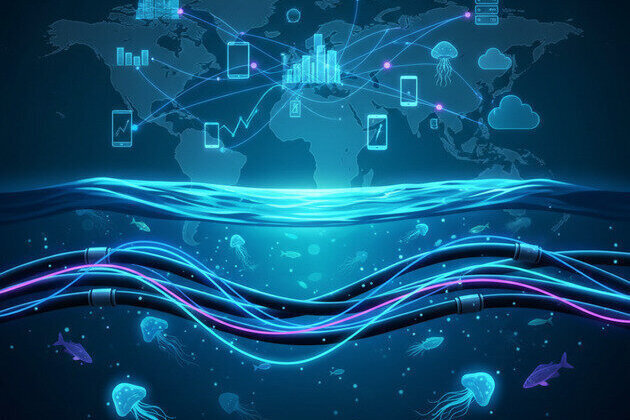
In the popular imagination, the internet is often depicted as an intangible cloud floating above the planet. The physical reality, however, is very different. Beneath the worlds oceans lies a vast network of fiber-optic cables that forms the true nervous system of the digital economy. More than 95 percent of global data traffic (including financial transactions exceeding USD 10 trillion daily in foreign exchange markets, diplomatic communications, digital platforms, and global e-commerce valued at more than USD 5.8 trillion annually) travels through submarine cables.
Today, there are more than 1.4 million kilometers of active cables. This silent infrastructure sustains a large portion of the contemporary digital economy.
For decades, these cables were viewed primarily as technical infrastructure. Today, however, they have become strategic assets. As economies, governments, and societies become increasingly dependent on digital connectivity (which represents roughly 15 percent of global GDP directly and indirectly, equivalent to more than USD 15 trillion annually), the control, security, and resilience of these networks acquire a clear geopolitical dimension.
Submarine cables are no longer simply data conduits. They are critical arteries of the international system.
Strategic Infrastructure Beneath the Ocean
More than 500 active cables carry the vast majority of international digital traffic. Each cable can transmit multiple terabits per second, enabling millions of simultaneous video calls or financial transactions.
Economically, their importance is difficult to overstate. Global financial markets alone process more than USD 710 trillion daily in currency transactions and over USD 500 billion in equity trading, much of it transmitted through these networks. Major digital platforms (whose combined market value exceeds USD 8 trillion) also depend on this infrastructure to operate their global services.
Unlike satellites, which carry less than 5 percent of global data traffic, submarine cables offer far greater capacity at lower cost. For this reason, they form the backbone of global connectivity. Simply put, the digital economy of the 21st century (moving tens of trillions of dollars annually) rests on this physical infrastructure installed on the ocean floor.
But their technical relevance has gradually evolved into strategic relevance. The infrastructure that carries data also carries power.
The Vulnerability of a Critical Network
One paradox of this global network is its relative fragility. Although cables are designed to operate for 20 to 25 years, between 150 and 200 interruptions occur each year due to ship anchors, industrial fishing activity, or geological events. In coastal reas (where more than 70 percent of global maritime traffic circulates) the risk of accidental damage is particularly high.
The economic consequences of a disruption can be significant. In regions highly dependent on a single international connection, a failure can disrupt financial services, telecommunications, and e-commerce worth more than USD 100 million per day.
In an interconnected world, the resilience of these networks has become a matter of national security. Several countries have begun incorporating submarine cable protection into their maritime defense strategies. The interest is understandable. A cable connecting two continents can carry economic and strategic information associated with trillions of dollars in digital activity each year.
For this reason, navies and regulatory authorities are increasingly monitoring this invisible infrastructure. It is not an exaggeration to say that, in some respects, the ocean floor has become a silent extension of the global strategic space.
Control of Data Flows
The strategic dimension of submarine cables extends beyond their physical vulnerability. It also relates to the ownership and control of the infrastructure.
For much of the 20th century, international cables were built by telecommunications consortia. Over the past fifteen years, however, the landscape has changed significantly. Large technology companies have invested more than USD 15 billion in new submarine cables to secure dedicated capacity for their digital services.
Companies such as Google, Meta, Microsoft, and Amazon (whose combined traffic accounts for more than 50 percent of global internet data flows) now participate in multiple digital infrastructure projects. Some recent cables have cost between USD 300 million and USD 600 million each, depending on their length and capacity.
This shift reflects a simple reality. Global digital platforms generate enormous flows of information that require their own infrastructure. Streaming services, e-commerce, cloud computing, and artificial intelligence depend on transmission networks that are increasingly fast and secure.
From a geopolitical perspective, this evolution raises new questions. Who controls global data routes? What regulatory frameworks apply to infrastructure that crosses multiple jurisdictions? How should commercial interests be balanced with national security concerns?
These questions become particularly relevant in a context of growing technological competition among major powers.
Technological Competition and Digital Geopolitics
The development of new submarine cable routes has become part of the global competition for digital infrastructure. Over the past decade, projects connecting the Americas, Europe, Asia, and Africa have been announced or built with investments exceeding USD 25 billion.
Digital connectivity has become a central component of the global economy. According to World Bank estimates, more than 60 percent of global GDP depends directly or indirectly on digital systems and data networks.
Controlling or influencing the infrastructure that enables this connectivity can translate into significant economic and technological advantages. For this reason, governments and corporations increasingly view each new submarine cable project not only as a technological investment but also as an element of strategic influence.
At the same time, the interconnected nature of the global network makes international cooperation indispensable. Submarine cables cross oceans, exclusive economic zones, and multiple legal jurisdictions. Their operation depends on technical agreements and shared regulatory frameworks.
An Invisible Infrastructure, A Real Power
The history of geopolitics has long been shaped by control over strategic infrastructure: maritime routes, pipelines, railways, and interoceanic canals. In the 21st century, digital infrastructure joins that list.
Submarine cables do not appear on traditional political maps, yet they are essential to the functioning of the global economy. Beneath the oceans flows the information that sustains trade, finance, and international communication; activities that together represent more than USD 100 trillion in annual global economic activity.
In this sense, the submarine cable network can be understood as a new layer of strategic infrastructure spanning the planet. Its expansion will continue alongside the growth of digital traffic, which, according to several projections, could double before 2030, driven by artificial intelligence, streaming, and cloud services.
On the surface, the world seems to move at the rhythm of political crises and daily headlines. Beneath the oceans, however, billions of pieces of data circulate silently every second. It is the infrastructure that sustains much of the 21st-century economy.
If an astronaut were to observe Earth from the silence of space, they would see a vast blue planet covered by seemingly calm oceans. What they would not see is the hidden infrastructure that carries much of the world's power.
Beneath the ocean floor runs a network of thousands of fiber-optic cables through which the information of the global economy flows. Financial transactions, diplomatic communications, digital platforms, and the constant stream of data connecting billions of people travel through these invisible arteries.
Just as early humans learned to master fire to survive, modern civilization has learned to master information. Yet the nervous system of the digital age is not in the clouds or in the satellites orbiting the planet.
It lies on the ocean floor.
There, far from public attention, pulses a silent infrastructure that carries a significant share of the worlds economic activity every second.
That may be why, if a distant observer tried to identify where the power of the modern world truly resides, they would not need to look at armies or borders. It would be enough to look at the ocean floor, where a silent network of cables connects continents and carries, along with data, an essential part of global power.
In the twenty-first century, power is measured not only in territories or armies, but also in the ability to control the invisible networks through which the planets information flows.
Short Bibliography
- International Telecommunication Union (ITU)
- Submarine Cable Resilience.
- Report explaining the role of submarine cables as critical global infrastructure. Estimates that they carry roughly 99 percent of international internet traffic.
- TeleGeography
- Submarine Cable Map & Industry Reports.
- Leading global database tracking the evolution of submarine cable networks.
- Center for Strategic and International Studies (CSIS)
- Safeguarding Subsea Cables: Protecting Cyber Infrastructure.
- Geopolitical analysis highlighting how submarine cables carry more than 95 percent of international data traffic and have become a domain of strategic competition.
- European Commission Digital Strategy
- Subsea Telecommunication Cables and Digital Connectivity.
- Report estimating that submarine cables carry between 97 and 98 percent of global internet traffic.
- International Cable Protection Committee (ICPC)
- Submarine Cables and the Oceans: Connecting the World.
- Technical reference on the physical infrastructure, security, and global operation of submarine cable networks.
Mauricio Herrera Kahn



 Share
Share
 Tweet
Tweet
 Share
Share
 Flip
Flip
 Email
Email